
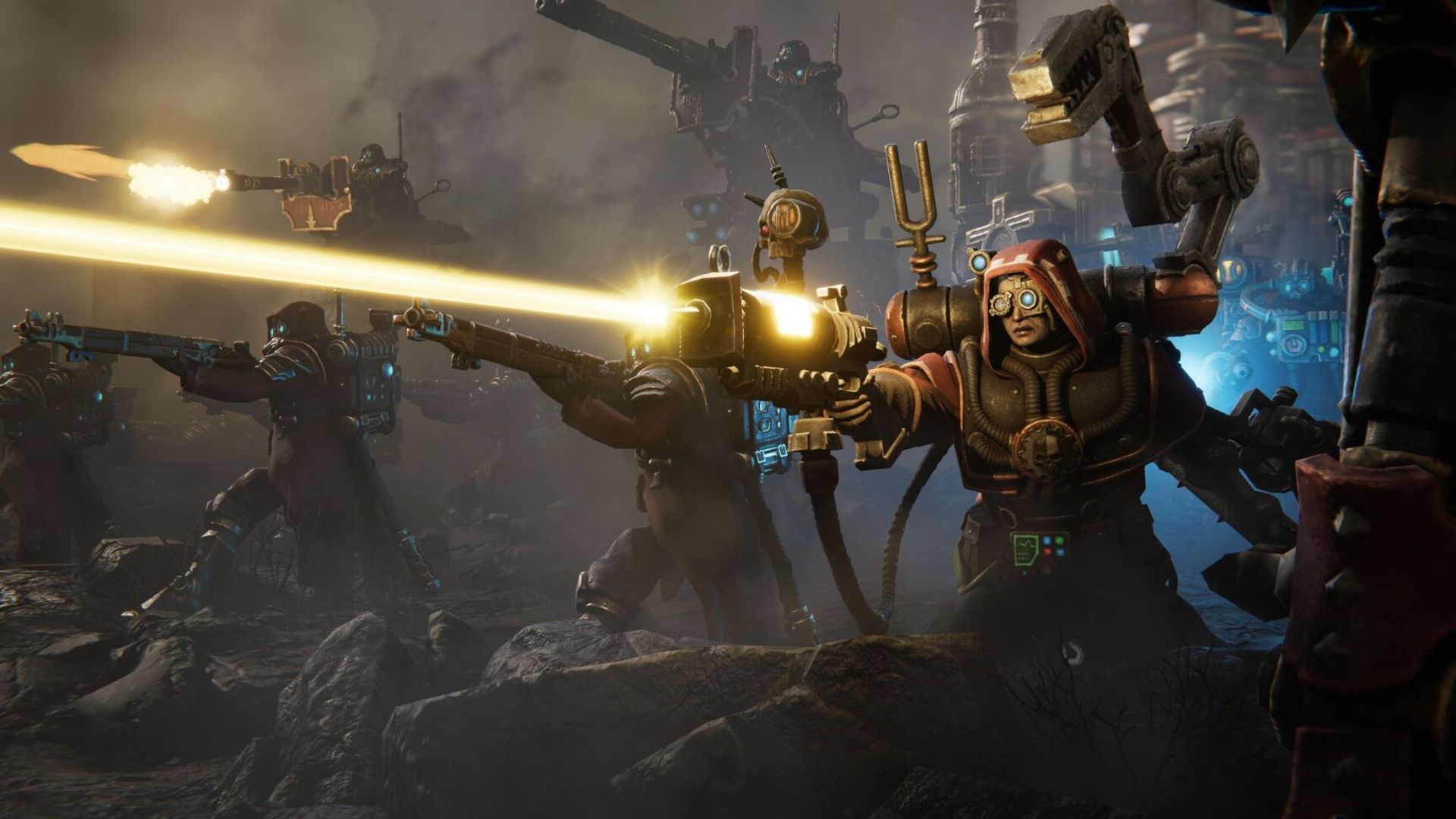
- Warhammer 40,000: Dawn of War 4 creative director Jan Theysen says the game's advanced animation system, Combat Director, initially "sounded pretty much impossible"
- The team figured out a solution by creating individual animation snippets that were stitched together for more complex battle animations
- Theysen says there were concerns that the system wasn't "responsive enough," so King Art had to be "flexible"
Warhammer 40,000: Dawn of War 4 creative director Jan Theysen has revealed that the game's advanced animation system, Combat Director, initially sounded like an impossible challenge until King Art found a solution.
Combat Director is Dawn of War 4's improved animation system that makes sync kills—special animations that occur when units stop fighting using generic animations and square up in a one-on-one fight to the death—more immersive across all melee combat.
This means that instead of syncing the last few attacks, King Art has chosen to sync everything in order to offer a more immersive experience. As the studio explained in a blog post, "In every combat scenario, our Combat Director continually assesses the situation. Who is around you right now? Who is the enemy? Who is supposed to damage whom, and in what manner?" This results in "millions and millions of potential animation combos playing out across different combat scenarios."
However, according to Theysen in an interview with TechRadar Gaming, the team didn't think it could pull it off at the beginning.
"Combat Director for us is the evolution of the singles. At some point, our head of animation said, 'I think we might be able to do this not only for kills, but basically for all melee combat,' which sounded pretty much impossible," Theysen said.
Despite the big undertaking, a core group of in-house animators found the solution; instead of creating whole animations, they just created like little animation snippets, then "what the system does is dynamically, depending on the situation in the game, it puts these snippets together to build animations out of it."
Theysen said "the big advantage" was the multitude of animation possibilities, but "our big concern was: is this not responsive enough?"
He explained, "If you watch someone fighting with sword versus sword, or someone is on your shoulder, and then there is an explosion, what happens, right? They need to react to the explosion, or if someone is fighting against someone else, and then a second character comes in and also wants to fight, how does that work?"
Essentially, King Art needed to make sure that it was "flexible" and make sure the units could leave animations at any point, adding that "the system figures out who is around me, who wants to fight me, who do I want to fight, and what kind of animations can I use to fight these two enemies?"
For example, if one unit is smaller and not as heavy and another is making a swing from the right, and the player has a chainsaw, Combat Director will run through all the possibilities that result in a procedural animation.
"The system basically says, okay, here are the options for what you could do, and then the system says, okay, I play these snippets to block the chainsaw and to actually hit the small guy," Theysen continued, "but then the system says, ah, nope, there was an explosion. So now, instead of hitting the small guy, you fly through the air, and that is basically how it works."
Warhammer 40,000: Dawn of War 4 arrives on PC on December 3.


